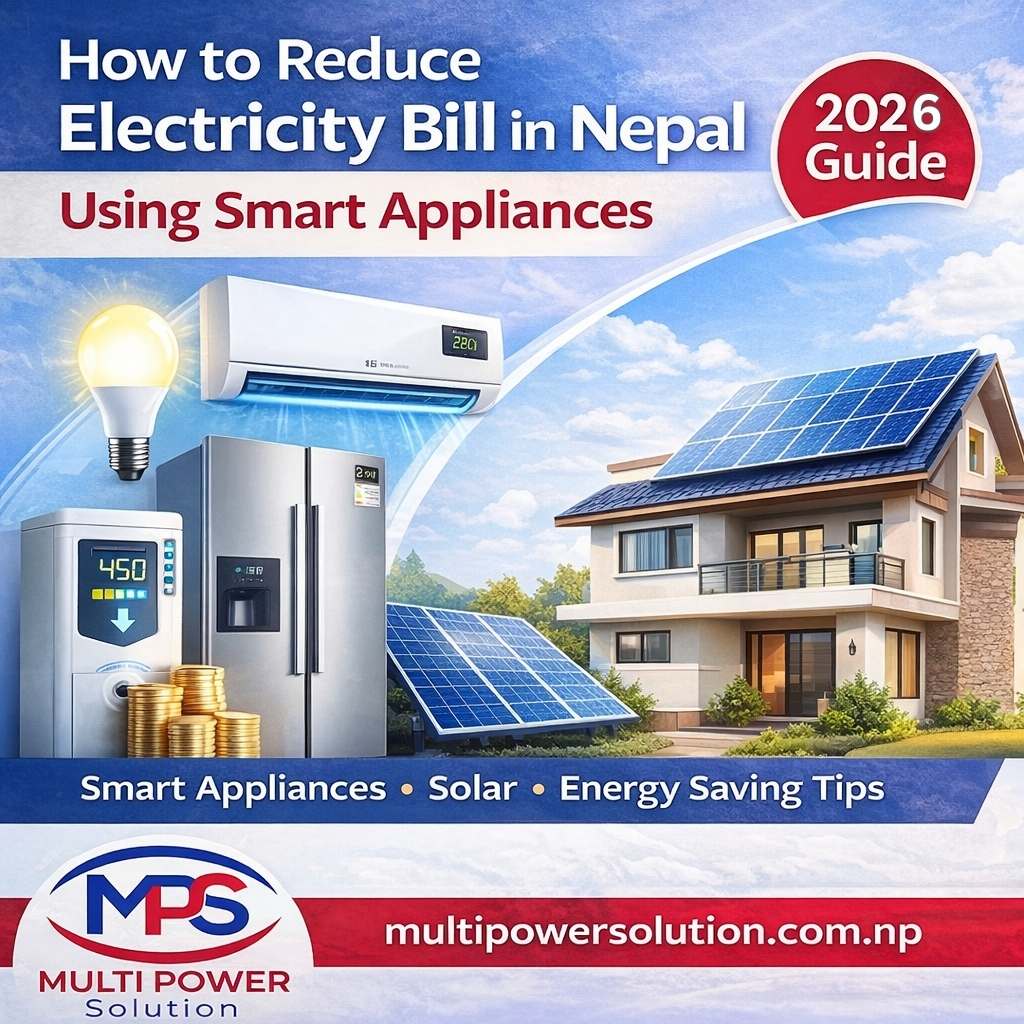
Rising electricity use, warming summers, and more modern appliances mean Nepali households are feeling the pinch at the monthly bill. The good news: smart appliances, good usage habits, and small investments can cut consumption substantially — often 20–40% — while improving comfort. This guide explains exactly how Nepali homeowners can lower their electricity bills using smart appliances and practical strategies.
Why this matters in Nepal
Nepal’s total electricity consumption has been rising as more households adopt modern appliances; the country recorded an all-time high in electricity sales and continuing growth in household usage. Average household consumption varies sharply: some low-use households consume under 10 kWh/month whereas others average over 100 kWh/month — urban areas like Kathmandu show much higher use. (CEIC Data)
Demand for cooling is one key driver: heatwaves and warmer summers have increased AC demand across Nepal, including in hill areas previously less likely to use AC. At the same time, the Nepal Electricity Authority (NEA) publishes tiered tariffs and minimum charges that make efficient use essential for savings. (Kathmandu Post)
How smart appliances save energy (the principle)
“Smart appliances” means two things in practice:
- Energy-efficient hardware — appliances built to use less electricity (inverter ACs, star-rated refrigerators, LED lighting, efficient pumps).
- Smart controls & behavior — devices with timers, thermostats, Wi-Fi controls, occupancy sensors, and energy-saving modes that run equipment only when needed.
Combining efficient hardware with intelligent control reduces wasted run-time, lowers peaks (which often cost more), and improves comfort — all of which translate directly into lower bills.
Top smart appliances and upgrades that give the best savings in Nepal
Below I list the appliance types that deliver the most savings in Nepal, why they work, and concrete tips on using them.
1. Inverter Air Conditioners (ACs) — biggest single impact for many homes
- Why: Inverter ACs modulate compressor speed to match cooling need instead of cycling full on/off. That reduces electricity draw, especially for long daily runtime. In warmer parts of Nepal (Tarai, urban Kathmandu in summer), ACs are the largest household load. (Kathmandu Post)
- Savings tip: Use a correctly sized inverter AC (not oversized), set thermostat to 24–25°C, clean filters monthly, and use ceiling fans to raise temperature setpoint. Combined, these cut AC energy use by 20–40% versus older non-inverter units.
- Buy/Install note: Professional installation (correct piping, commissioning, and earthing) matters — poor install can erase efficiency gains.
2. LED Lighting + Smart Controls
- Why: Replacing incandescent or CFL bulbs with LEDs reduces lighting energy by 70–90%. Smart switches and motion sensors stop lights when rooms are empty.
- Savings tip: Prioritize living rooms, kitchens, and outdoor lights. Use motion sensors for corridors and bathrooms.
3. Star-rated Refrigerators and Freezers
- Why: Refrigerators operate continuously; a modern high-star unit uses significantly less electricity than a decade-old model.
- Savings tip: Choose right capacity for household size, place away from direct sun, avoid overpacking, and keep door seals intact.
4. Solar-ready Appliances & Solar Water Heaters
- Why: Solar water heaters remove the single biggest electric heating load (geysers). Rooftop PV plus grid export (net metering) also offsets daytime loads. Nepal’s solar resource and rising rooftop interest support adoption. (ResearchGate)
- Savings tip: Install evacuated tube solar water heaters for consistent winter performance; pair rooftop PV with daytime loads like water pumping or washing machines.
5. Smart Plugs, Timers & Home Energy Management
- Why: Many devices draw standby power. Smart plugs let you schedule or completely cut power to entertainment systems, chargers, and pumps. Combined with a basic home energy monitor, you can target the biggest energy draws.
- Savings tip: Use timers for water heaters and washing machines to avoid running during peak tariff windows if you have time-sensitive pricing.
Practical roadmap: Lower your bill in 90 days
This is a simple step-by-step plan you can follow.
Week 1 — Audit (free or cheap):
- Check last 3 months of electricity bills (kWh per month). Note peak months. NEA data shows household consumption varies widely — know where you stand. (Kathmandu Post)
- Walk through home: list all big loads (ACs, fridge, water heater, pumps).
Week 2–3 — Low-cost fixes (Rs-level)
- Replace incandescent bulbs with LEDs (most cost-effective).
- Fit smart plugs on TVs, chargers, PC to cut standby loads.
Month 2 — Medium investments (thousands of NPR)
- Clean and service ACs; install ceiling fans and set thermostats to 24–25°C.
- Replace old fridge with a 3- or 5-star model if it’s over 10 years old.
Month 3 — Bigger investments & renewables
- Consider inverter AC when replacing, and a solar water heater to eliminate electric geyser costs. Solar water heaters pay back in ~3–4 years in many Kathmandu cases. (CEIC Data)
- Add basic rooftop PV if feasible (net metering policies expanding).
How much can you realistically save?
Estimates depend on starting consumption, but typical ranges:
- LEDs & smart plugs: 5–10% savings
- Efficient fridge replacement: 10–15% of household electricity
- Switching to inverter AC + habits: 20–40% for households with heavy AC usage
- Solar water heater: near-elimination of geyser electricity use → big savings (Rs. 20k–40k/year possible) in many homes. (ResearchGate)
Because tariffs and consumption patterns vary across Nepal, calculate expected savings using your current kWh/month × local NEA tariff rates for an accurate estimate. NEA publishes tariff slabs and categories for domestic consumers. (nepalenergyforum.com)
Smart behaviors that multiply appliance efficiency
- Use time-of-use sensibly. If your area has higher daytime rates or if you use diesel backup, shift non-urgent loads to cheaper hours.
- Avoid phantom loads. Unplug chargers and entertainment systems when not in use, or use smart strips.
- Maintain appliances. Dirty AC filters and clogged fridge coils reduce efficiency. Annual servicing improves performance.
- Use the right size appliance. Oversized ACs short-cycle; oversized pumps waste energy; too large refrigerators use more than needed.
What to look for when buying smart appliances in Nepal
When purchasing, consider:
- Energy ratings (star labels) and real-world testing data.
- Local service network: Availability of technicians and spare parts in Kathmandu Valley and regions. NEA and industry reports show increasing adoption — after-sales matters. (NEA)
- Warranty & installation: Many manufacturers require professional installation to keep warranty valid.
- Smart features: Timers, Wi-Fi control, and eco-modes are useful only if you plan to use them.
Barriers & solutions specific to Nepal
Barrier: Voltage fluctuations and unreliable power in some regions can harm electronics and reduce efficiency.
Solution: Use good stabilizers, choose rugged appliances designed for the region, and consider solar + battery solutions for sensitive loads.
Barrier: Upfront cost for efficient models and solar systems.
Solution: Prioritize measures with shortest payback (LEDs, fridge replacement, AC servicing), then invest savings into bigger upgrades.
Barrier: Limited consumer awareness.
Solution: Education (blogs, in-store demos) and local installers offering energy audits help adoption.
Case example (illustrative): Kathmandu family saves ~Rs. 18,000/year
A 4-member household in Kathmandu replaced 6 incandescent bulbs with LEDs, serviced their 1.5-ton AC and set it to 25°C, replaced an old fridge with a 3-star model, and installed a solar water heater for hot water. Their combined monthly electricity dropped from 320 kWh to ~240 kWh — roughly 25% savings, equating to about Rs. 18,000 per year on typical tariffs. (Example uses typical Kathmandu consumption patterns and device efficiencies; results vary.) (Kathmandu Post)
How Multi Power Solution / Local installers can help (practical next step)
If you prefer a done-for-you approach, reputable local providers offer:
- Home energy audits (identify biggest waste)
- Professional installation of inverter ACs, solar water heaters, efficient refrigerators, LED retrofits, and smart plugs
- AMC (annual maintenance contracts) to keep systems efficient
Choose providers with local references in Kathmandu, Bhaktapur, and Lalitpur and clear service guarantees.
FAQs
FAQs
Q1: Can smart appliances really reduce my electricity bill in Nepal?
Yes. Smart appliances (inverter ACs, efficient fridges, LEDs, solar water heaters) plus good usage habits can reduce household bills by 20–40% depending on your baseline consumption. (Kathmandu Post)
Q2: Is it worth replacing my old fridge or AC?
If your fridge or AC is over 8–10 years old, replacing with an energy-rated model typically pays back in 3–5 years through energy savings. (CEIC Data)
Q3: Do solar water heaters work in Kathmandu winter?
Yes — evacuated tube (vacuum) collectors perform well even in cooler months and are widely used in Kathmandu. They often eliminate electric geyser use in many homes. (ResearchGate)
Q4: Are inverter ACs better for Nepal’s electricity situation?
Yes. Inverter ACs are more energy efficient and adapt to varying loads, making them well suited to Nepal’s rising AC demand and variable power contexts. Proper installation is crucial. (Kathmandu Post)
Q5: How do I pick a reliable installer in Kathmandu?
Look for installers with local references, warranty on installation, trained technicians, and transparent audits. Ask for before/after usage estimates and service plans.
Quick checklist to start saving today
- Replace 5–10 highest-use bulbs with LEDs
- Clean AC filters monthly; service annually
- Install smart plugs on standby devices
- If replacing AC or fridge, choose inverter / high-star models
- Consider a solar water heater to remove the geyser load
- Get a home energy audit and a professional installer for big changes
Final word
Reducing electricity bills in Nepal is both practical and affordable when you combine smart appliance choices with better usage habits and selective investments in renewables like solar water heaters or rooftop PV. Start small, measure results, and reinvest savings into the next round of upgrades — that’s how many Nepali households create a virtuous cycle of comfort and savings.