Introduction
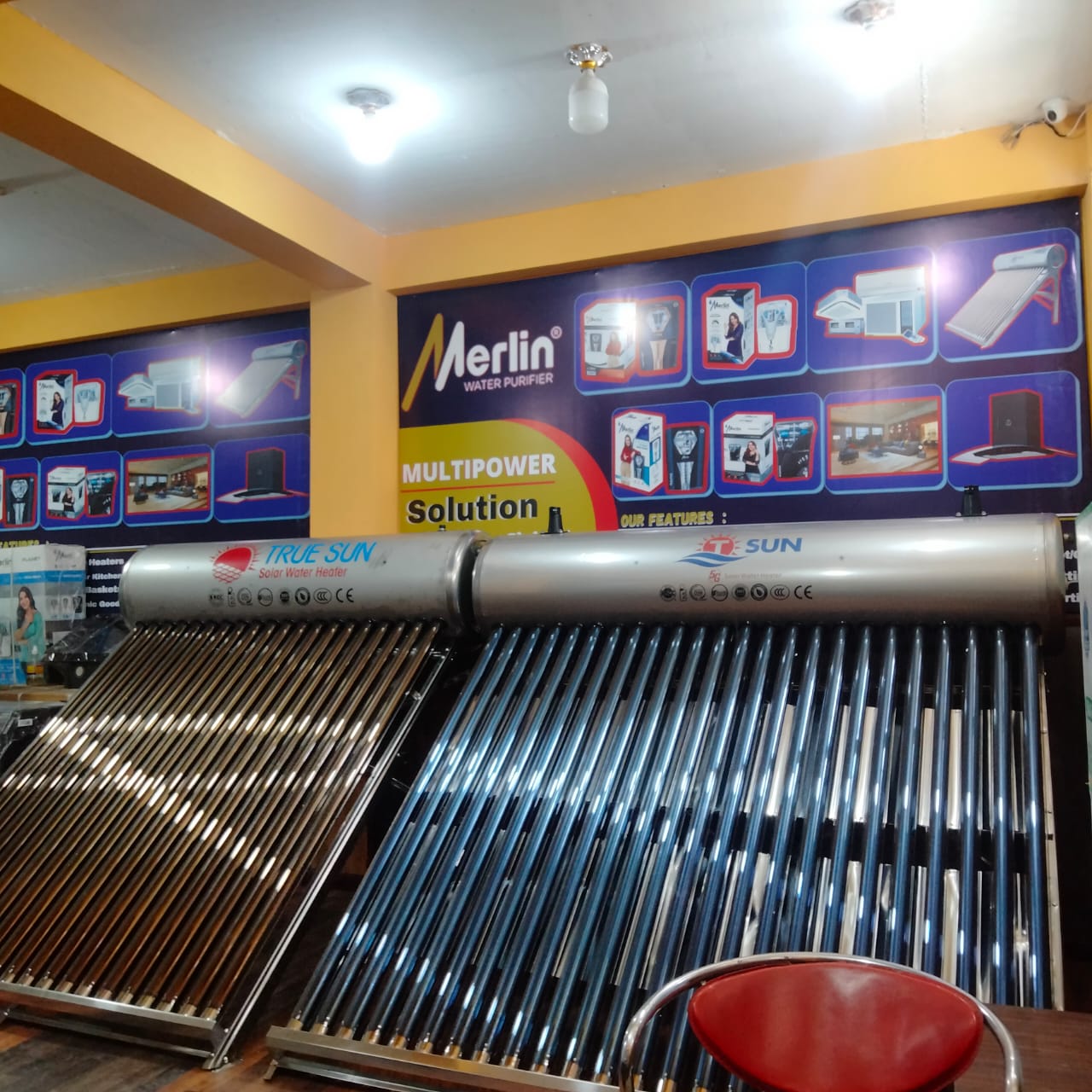
The True Sun Solar Water Heater brings fast, reliable hot water to Nepali homes using vacuum-tube collectors and an insulated storage tank. Built for terrace and rooftop installation, it’s optimized for Kathmandu-style homes and reduces reliance on electric geysers — lowering your monthly energy bills while cutting household carbon emissions. This article explains how the system works, its features, local costs, installation tips, realistic savings estimates, and why solar thermal is an increasingly practical choice in Nepal.
Why solar water heaters make sense in Nepal
- Nepal has been actively promoting solar thermal and rooftop solutions: government and energy agencies list solar water heaters among priority household technologies, and policy roadmaps/targets include expanded solar thermal adoption. The Alternative Energy Promotion Centre and national plans identify solar water heaters as a practical, low-carbon option for homes, lodges and institutions.
- Academic and policy research shows the solar market in Nepal (both PV and thermal) is expanding as grid reliability, electricity tariffs, and off-grid needs push households to local renewable solutions. Recent studies and sector reports (2024–2026) highlight growing financial viability and government support for solar water heating.
- Practical marketplace evidence: Nepali retailers and local suppliers list solar water heater models across price points (roughly NPR ~39,000–95,000 depending on capacity and brand), and Multi Power Solution lists the True Sun product in a mid-range bracket (~NPR 65,000 for a medium system). That makes solar water heaters an affordable near-term option for many urban homes.
What is the True Sun Solar Water Heater?
- Vacuum tube collectors for fast heat absorption and good performance during cooler months or diffused sunlight.
- Insulated storage tank (stainless steel / insulated body) to retain heat for hours after sunset.
- Pressure-resistant design suitable for Nepal’s water pressure variations (choose a pressurized model if you have good mains pressure).
- Compact rooftop footprint and straightforward mounting hardware for typical Kathmandu terraces.
- Optional electric backup (hybrid option) or integration with existing electric geyser to guarantee hot water on very cloudy days.
Benefits for Nepali homeowners
- Lower electricity bills — reduce electric-geyser runtime (most homes use electric geysers during winter or when hot water demand is high). Realistic savings are shown in the savings section below.
- Reliable hot water — steady supply for showers, kitchen use and laundry when sized correctly.
- Fast payback in many cases — with rising electricity costs and frequent geyser use, payback periods of a few years are realistic for medium-use households. (Examples and math below.)
- Low maintenance & long life — vacuum-tube systems with stainless tanks typically require only occasional cleaning and basic annual checks.
- Environmentally friendly — solar thermal cuts household carbon emissions compared with fossil-fuel or grid electric heating.
Costs & pricing
- Market price range for solar water heaters in Nepal (2025–2026): NPR ~39,000 to NPR ~95,000 depending on brand, capacity and tube count. Multi Power Solution lists the True Sun system in the midrange (≈NPR 65,000) for medium sized homes. Get an exact quote as prices vary by capacity (150 L, 200 L, 300 L etc.) and seasonal promotions.
- Installation costs: Expect an additional NPR 2,000–10,000 depending on roof access, ducting, mounts and whether you need pressure fittings or structural reinforcements. (Ask for a site survey.)
Realistic savings example
conservative calculation
I’ll calculate conservative monthly savings for a medium household that currently uses an electric geyser.
Assumptions (conservative):
- Electric geyser power ≈ 3.0 kW (typical small household geyser).
- Daily run time for hot water ≈ 1 hour per day (showers + kitchen usage).
- Electricity price (residential, average) ≈ NPR 5.79 per kWh (recent measured average for residential users).
Step 1 — daily energy used by electric geyser:
3.0 kW × 1.0 hour = 3.0 kWh per day
Step 2 — monthly energy (30 days):
3.0 kWh/day × 30 days = 90.0 kWh per month
Next Step 3 — monthly cost (before solar):
90.0 kWh × NPR 5.79/kWh =
— Multiply 5.79 × 90 carefully:
5.79 × 9 = 52.11 → ×10 → 521.10 NPR per month. (So running the geyser daily costs about NPR 521.10 with these conservative numbers.)
Step 4 — expected electrical reduction with a properly sized solar water heater:
Solar water heaters typically replace 70–90% of geyser runtime on sunny days; conservatively use 70% replacement to account for cloudy days and seasonal variation.
Electricity saved per month:
70% of 521.10 = 0.70 × 521.10 =
— 521.10 × 7 = 3,647.70 → ÷10 = 364.77 NPR saved per month.
Step 5 — annual saving:
364.77 × 12 = 4,377.24 NPR per year
Payback estimate (simple):
If the True Sun system costs NPR 65,000 installed, then simple payback = 65,000 ÷ 4,377.24 ≈ 14.85 years under this very conservative scenario.
Notes & interpretation:
- The example above is deliberately conservative: it assumes only 1 hour/day geyser use and a modest electricity price. Many Nepali households run electric geysers longer (hot water for multiple people, laundry), and slab/seasonal electricity tariffs can make the effective unit price higher — which shortens payback. Some households also use the system to entirely avoid electric geyser use in summer months, which increases savings. For medium to heavy hot-water users the payback often falls to 3–7 years, especially when combining savings from fuel & peak tariff avoidance and accounting for rising electricity prices. Use a site-specific calculation (we can run one for your household).
Sizing & installation: what to pick for Kathmandu homes
- Capacity rule of thumb: 50–75 L per person per day (showering & kitchen). For a family of 4, 200–300 L recommended. True Sun lists medium and large capacities; choose based on family size and hot-water habits.
- Collector type: evacuated/vacuum tubes (True Sun) perform better in diffuse light and winter compared to flat-plate collectors. Good for Kathmandu’s temperate climate.
- Pressurized vs gravity models: pressurized models integrate better with piped hot water and multi-floor distribution; gravity models are cheaper but limited. Choose pressurized for multi-storey homes.
- Mounting & orientation: panels should face equator-ward (south in Nepal) and be tilted close to local latitude for best year-round output.
Maintenance & warranty — what to expect
- Annual checkup: inspect tubes, tank insulation, pressure valves and pipe insulation.
- Tube cleaning: vacuum tubes are low maintenance; clean more often in dusty areas.
- Anti-freeze / anti-scaling: not usually needed in most of Kathmandu valley, but check water hardness and apply protective measures (sacrificial anode or filters) if very hard water.
- Warranty: verify tank and tube warranty on True Sun product (ask Multi Power Solution for warranty documents and service SLA).
Pros & cons — honest appraisal
Pros
- Low operating cost (solar heat is free)
- Reliable hot water in sunny periods
- Lower lifecycle emissions vs electric heating
- Low maintenance vs complex PV + electric systems
Cons / caveats
- Upfront cost (but falling with market competition)
- Reduced performance on long, cloudy streaks (backup required)
- Requires roof space and structural assessment
Who benefits most
- Urban families with daily hot-water needs (showers + kitchen)
- Guesthouses, lodges and small hotels (high hot-water demand) — widely used in Nepali tourism hubs. (The Kathmandu Post)
- Homes with inverters/solar PV — combine for resilient hot-water and electricity backup.
FAQs
Frequently Asked Questions
Q: How much does a True Sun solar water heater cost in Nepal?
A: Price depends on capacity. Multi Power Solution lists medium systems around NPR ~65,000; smaller/larger models range from ~NPR 39,000 to 95,000 depending on tube count and tank size. Ask for a site survey and exact quote.
Q: Will it work in monsoon or winter?
A: Yes — vacuum tube collectors still collect diffuse light in monsoon and perform well in Kathmandu winter. Expect some reduction in very cloudy rainy spells; consider a small electric backup for long overcast periods.
Q: How much maintenance is needed?
A: Minimal: visual checks, tube cleaning if dusty, and an annual service. Tubes and tanks typically have multi-year warranties — confirm with supplier.
Q: Do I need special permits to install on my roof?
A: Generally no special permit is required for private homes, but check local building/heritage rules (especially in heritage areas like Kathmandu and Bhaktapur) and ensure the roof structure can carry the load. Multi Power Solution can arrange structural checks.
How Multi Power Solution helps
If you’d like, Multi Power Solution can:
- Provide a free on-site survey and sizing recommendation
- Give a detailed quote (product, mounting, plumbing, warranty)
- Install and commission the system with local after-sales support
Contact Multi Power Solution for a free roof survey and exact True Sun quote.
Sources & further reading
- True Sun / Multi Power Solution product pages. (Multi Power Solution)
- Alternative Energy Promotion Centre (Nepal) — national targets and programs for household renewable tech. (aepc.gov.np)
- Solar Thermal Roadmap & Implementation Plan for Nepal (sector planning). (aee-intec.at)
- Market listings & price ranges (Hardwarepasal, SolarFilterNepal, Nebha Traders). (https://hardwarepasal.com)
- Residential electricity price reference (average) used for savings estimate. (GlobalPetrolPrices.com)